Paris is Getting a New Horizon: The Story of Tour Triangle and What It Means for the City
For fifty years, Paris has been a city that looks outward rather than upward. The Parisienne skyline, all zinc rooftops and limestone cornices, has remained largely unchanged due to strict legal protections. In one corner of the 15th arrondissement however, Paris has a new vantage point.
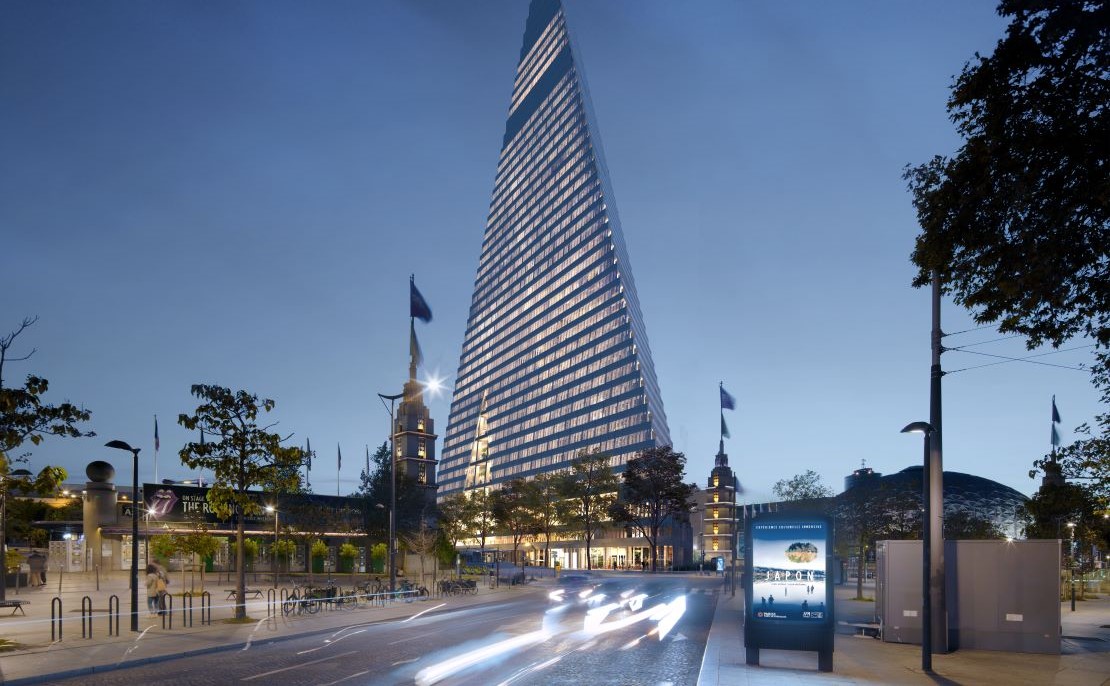
After nearly two decades of development, building, and construction, the Tour Triangle has reached its full height. A 180-meter glass pyramid standing at the Porte de Versailles, the tower is visible from well beyond the périphérique (the ring road surrounding Paris). It is one of three towers Paris allowed to rise above its height limits after 2010, alongside the Tribunal de Paris at Batignolles and Jean Nouvel’s Tours Duo, and it is the most visible of them. With the 37-meter limit now restored, it is also expected to be the last tower of its scale the city permits.
This is the story of how Tour Triangle came to be, what it contains, and what it changes about the way Paris is seen — and how Paris sees its own horizons.
What Is the Tour Triangle in Paris?
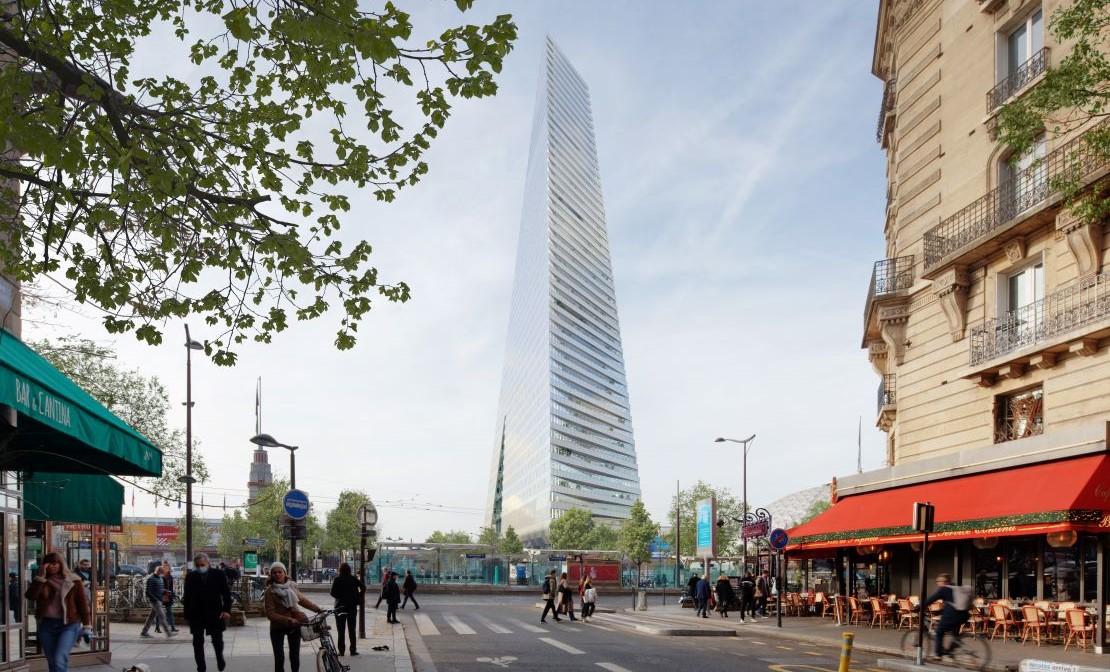
The Tour Triangle is a 180-meter mixed use skyscraper with 44 levels. Shaped as a glass pyramid on a trapezoid base, it is the third-tallest structure in Paris and is scheduled for inauguration in spring 2027. While the project is still widely known as Tour Triangle, the completed building will open under the name TRIANGLE.
It is a building that refuses to be one thing. The triangular floor plan produces dramatically different profiles depending on where you stand: from central Paris the tower reads as a slim glass blade, while from the east and west its full triangular shape is unmistakable. The effect is deliberate. It is a structure designed to feel different from every side, rather than fixed in a single silhouette.
How Tall Is the Tour Triangle, and Where Is It Located?
Tour Triangle stands 180 meters tall, with a ground floor and 43 upper levels, at the Porte de Versailles, on the southwestern edge of Paris beside the Parc des Expositions. It is the third-tallest building in the city, after the Eiffel Tower and the Tour Montparnasse, and sits directly on Métro line 12 and the tramway network.
Where It Sits
For the Tour Triangle in Paris 15, the address matters as much as the elevation. This is not the historic center. It is the city’s hem, the line of the old fortifications where Paris meets the boulevard des Maréchaux and the ring road beyond. The site sits at the crossroads of Paris, Issy-les-Moulineaux and Vanves, which is why its architects describe the tower as a new link between the historic center and Greater Paris. On the cusp of old and new, this location is part of what made the project possible at all.
Paris Expo and the Neighborhood
aris Expo Porte de Versailles, operated by Viparis, hosts around 200 events and more than 5.5 million visitors a year, and its operator ranks it among Europe’s largest exhibition centers. Construction of the exhibition grounds began in 1923, driven by the success of the Foire de Paris, and the first show opened there in January 1925. Viparis launched a modernization program in 2015 that has been rebuilding the pavilions, with a final phase scheduled to run until 2028. During the 2024 Olympic and Paralympic Games, Paris Expo was the largest venue in the capital, hosting seven sports and more than one million spectators. Around it, Porte de Versailles is shifting from a trade-fair district into a mixed one, with new hotels, rooftop bars and workplaces, and TRIANGLE is its most visible marker.
Ground Level and Public Realm
Known in French as the immeuble Triangle, the tower stands on a 7,435-square-meter plot bordered by avenue Ernest Renan, rue de la Porte d’Issy and rue d’Oradour-sur-Glane. Its base is open to the public along avenue Ernest Renan, where the architects plan a daycare center, a health center, a cultural center, restaurants, cafés and shops to recreate a lively street frontage. Métro line 12 and trams T2 and T3a stop at Porte de Versailles, with bus routes and Vélib’ bike-share stations nearby. The base also holds more than 800 bicycle parking spaces, which builder BESIX describes as one of the largest bicycle parking facilities in Paris. The public side continues at the summit, where a panoramic restaurant and belvedere occupy the top four floors, and where SUMMIT Paris opens to visitors in 2027.
Who Designed the Tour Triangle?
Tour Triangle was designed by Herzog & de Meuron, the Basel practice of Jacques Herzog and Pierre de Meuron, in collaboration with Valode & Pistre. Herzog & de Meuron are known internationally for the Bird’s Nest Olympic stadium in Beijing and for the conversion of London’s Bankside power station into Tate Modern.
That pedigree is instructive. Both buildings are exercises in making something monumental feel civic rather than imposing, and the same instinct runs through the Triangle. Herzog & de Meuron began work on the project in 2006, which means the practice has spent almost two decades shaping a single building in a city deeply attached to its skyline. When the tower topped out in April 2026, Christoph Roettinger, the Herzog & de Meuron partner in charge of the project, described Triangle as “a destination designed and open to all.
Why Hasn't Paris Built a Major Skyscraper in Over 50 Years?
Paris stopped building tall after the Tour Montparnasse opened in 1973 and prompted lasting public debate about height. A 37-meter height limit was in force from 1977 until 2010, when Mayor Bertrand Delanoë lifted it to permit office towers of up to 180 meters. That temporary change of rule is what made Tour Triangle legally possible.
Why Do Some Parisians Dislike the Tour Montparnasse?
The Montparnasse story is the one every Parisian knows. One lone modern tower was built into a city of historic and low-rise buildings, and prompted such debate on arrival that height cap regulations followed within a few years. For half a century it shaped how Paris approached tall buildings, and every subsequent proposal was measured against that debate.
The Window That Opened in 2010, Before Height Limits Returned
Paris built tall in the intervening years. Jean Nouvel’s Tours Duo rose in the 13th arrondissement in the early 2020s. However, they sit east of the center, away from the axes most visitors walk, so they have far less presence in city’s most iconic views. Tour Triangle is the first tower since 1973 approved at a scale and location that genuinely alters the silhouette Paris has guarded for half a century.
Under current planning rules, the legal window these buildings came through is no longer open. The city’s bioclimatic urban plan, first voted in 2023 and definitively approved on November 20, 2024, restores the 37-meter height limit.
What Is Inside The Tour Triangle?
Tour Triangle has a gross floor area of about 95,500 square meters, according to its architects, most of it workspace. The program also includes ground-level retail, a crèche at mid-height, a hotel, restaurants, a health center, a conference center, a cultural venue and publicly accessible spaces, culminating in a new experience at the summit: SUMMIT Paris.
A Vertical Quarter, Not an Office Block
The Enviromental Case
The tower was pitched on an ecological promise, and the most visible expression of it is the facade: photovoltaic panels set into the recesses of the south edge, which the architects say will produce enough energy to light a third of the workspaces. Geothermal installations cover part of the heating and cooling, and the project targets BREEAM Outstanding and HQE Exceptional certification, according to builder BESIX.
When Will the Tour Triangle Open?
Tour Triangle is scheduled for inauguration in spring 2027. The tower reached its definitive height in 2026.
The project’s director general at Unibail-Rodamco-Westfield described the remaining work as interior finishes, architectural trades, decoration and climate systems, with final delivery in early 2027. The most recent reporting puts inauguration in the spring of that year.
The schedule has moved before, and generously. Delanoë presented the project in 2008 expecting completion within a few years. Construction finally began in February 2022, 14 years after the project was announced .
How Will the Tour Triangle Change the Paris Skyline?
Tour Triangle gives the Paris skyline a new landmark on its southwestern edge. At 180 meters it shares third place with Tour Duo 1, behind the Eiffel Tower and the Tour Montparnasse. Because it stands at the city’s edge rather than its center, it reads as a new gateway to contemporary Paris.
This is an important achievement of the location. From most of the historic core, the tower is invisible or incidental. From the south and west it is visible from further and further away, and it has already begun to function as a landmark for a quarter that previously had none.
The most significant change may be how TRIANGLE transforms the experience of seeing Paris itself. Paris has long offered few public places to see the city from real height, and the Tour Montparnasse observatory, one of the best known, closed for several years of renovation in March 2026. In 2027, a new public belvedere will open at the top of Tour Triangle. There, SUMMIT Paris will invite visitors not simply to look at the city, but to experience it through shifting perspectives, reflections, light, and the ever-changing dialogue between the urban landscape, the sky, and the city’s people.
What Is SUMMIT Paris?
SUMMIT Paris is a new experience coming to the top of Tour Triangle in 2027, offering a new way to appreciate Paris from above. Further details will be revealed closer to opening.